Peters Township 724-942-4229

Invisalign vs. Braces for Crowding: What Actually Determines the Right Choice?
Crowded teeth are one of the most common reasons people consider orthodontic treatment. Maybe your front teeth overlap, one tooth sits behind another, or your smile has gradually become more crowded over time. When you start researching solutions, two options often appear at the top of the list: Invisalign and traditional braces.
But choosing between them is not simply a matter of deciding whether you prefer clear aligners or braces. The right treatment depends on how much crowding you have, how your bite fits together, how your teeth need to move, and how consistently you can follow your treatment plan.
For patients considering Invisalign in Pittsburgh, understanding these factors can make the decision much easier. At Sepic & Madison Orthodontics, we provide personalized orthodontic evaluations to determine which approach is appropriate for each patient’s smile, bite, and treatment goals.
Why Does Dental Crowding Happen?
Dental crowding occurs when there is not enough available space for teeth to fit properly within the dental arches. As a result, teeth may overlap, rotate, tilt, or erupt in an unusual position.
Crowding can develop for several reasons, including:
- Tooth size and jaw size
- Genetics
- Loss of baby teeth too early
- Teeth erupting in an unusual position
- Changes that occur as the mouth develops
- Previous orthodontic treatment followed by relapse
- Lack of adequate space within the dental arch
Crowding is not always purely cosmetic. Overlapping teeth can sometimes make brushing and flossing more difficult because certain areas are harder to reach.
That is why an orthodontic evaluation looks at more than how your smile appears.
Invisalign vs. Braces: What’s the Difference?
Both Invisalign and braces are designed to move teeth into healthier and more functional positions, but they use different approaches.
How Invisalign Works
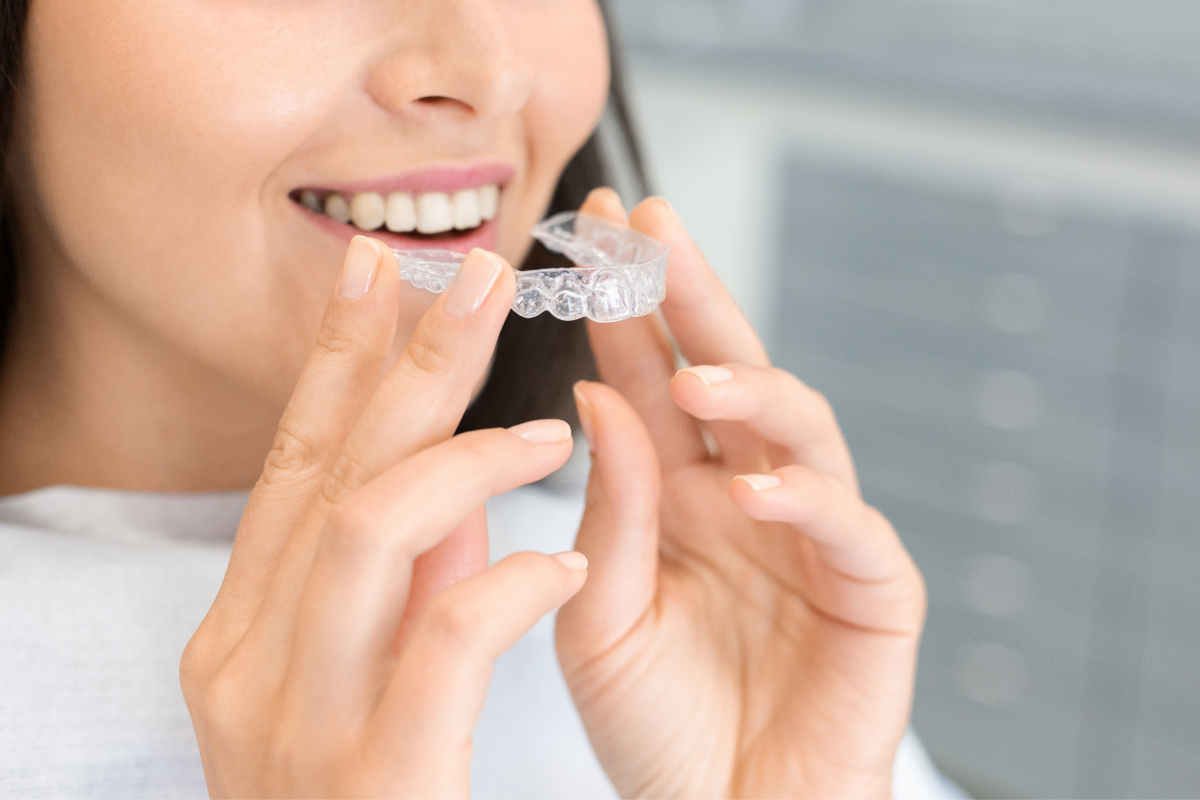
Invisalign uses a series of clear, removable aligners that are custom-designed to gradually move the teeth.
The aligners can be removed when eating, drinking certain beverages, brushing, and flossing. However, because they are removable, successful treatment depends heavily on wearing them as instructed.
Invisalign may be particularly appealing to patients who want:
- A discreet orthodontic option
- Removable trays
- Easier access to brushing and flossing
- Fewer food restrictions
- A treatment option that fits into an active lifestyle
Clear aligners have also become increasingly capable of addressing a wider range of orthodontic concerns. However, whether they are appropriate for a particular case depends on the movements required and the patient’s individual diagnosis.
How Braces Work
Traditional braces use brackets and wires attached to the teeth. The orthodontist adjusts the system throughout treatment to guide teeth into their planned positions.
Because braces remain attached throughout treatment, patients do not have to remember to put them back in after eating or cleaning.
Braces can be particularly useful when treatment involves:
- Significant crowding
- Complex tooth rotations
- More substantial bite corrections
- Teeth requiring precise movement
- Cases where patient compliance with removable aligners could be difficult
The decision is not necessarily about which treatment is “better.” It is about which system is better suited to the movements your teeth and bite require.
How Much Crowding Do You Have?
One of the most important factors in deciding between Invisalign and braces is the severity of your crowding.
Orthodontists can assess the difference between the amount of space available and the amount of space needed to properly align the teeth. This helps determine the complexity of the case.
Mild Crowding
With mild crowding, there may only be a small amount of overlap or rotation.
In many cases, both Invisalign and braces may be considered. The decision may then depend more heavily on:
- Your treatment goals
- Your lifestyle
- Your preference for removable or fixed treatment
- Your ability to follow aligner wear instructions
- Your overall bite
Moderate Crowding
Moderate crowding may require more involved tooth movement and careful space management.
Invisalign can be an option for many patients with moderate crowding, but the orthodontist must determine whether the planned movements can be achieved predictably with aligners.
Braces may also be recommended when greater control over individual tooth movements is needed.
Severe Crowding
More severe crowding can involve substantial overlap, rotations, limited space, or additional bite concerns.
In these cases, traditional braces may provide advantages because they allow the orthodontist to apply precise forces to individual teeth. Some complex cases can still be treated with clear aligners, but suitability should be determined through an individualized evaluation rather than the severity of crowding alone.
Your Bite Matters Just as Much as Your Crowding
A common mistake is to look only at crooked teeth.
An orthodontist also examines how the upper and lower teeth fit together. A patient may have crowding combined with an overbite, underbite, crossbite, or open bite.
These factors can significantly influence treatment planning.
For example, an orthodontist may evaluate:
- How far the upper teeth overlap the lower teeth
- Whether the lower teeth sit too far forward
- Whether upper teeth sit inside the lower teeth
- Whether certain teeth fail to contact properly
- Whether the dental arches are properly coordinated
- Whether individual teeth need significant rotation or vertical movement
This is why an online quiz or general recommendation cannot determine whether Invisalign or braces are right for you.
Do You Need Tooth Removal to Create Space?
Some patients with significant crowding may require additional space to align their teeth properly.
Depending on the individual situation, an orthodontist may consider different approaches to space management. In some complex cases, tooth extraction may be part of the treatment plan.
If extractions are necessary, the type and complexity of tooth movement required afterward can influence whether braces or clear aligners are recommended.
That does not mean Invisalign can never be used in an extraction case. Modern aligner treatment can address many different orthodontic concerns, but the orthodontist must determine whether the planned movements are appropriate for aligner therapy.
How Much Control Does Your Treatment Require?
Another important consideration is the type of tooth movement needed.
Simple alignment is different from moving a tooth vertically, correcting a significant rotation, controlling the position of the tooth root, or coordinating a complicated bite.
Invisalign May Be a Good Fit When:
- Crowding is mild to moderate
- The required tooth movements are appropriate for aligner therapy
- You are comfortable wearing removable aligners consistently
- You want a discreet treatment option
- You value being able to remove your appliance when eating and cleaning
Braces May Be Preferred When:
- Crowding is more complex
- Significant rotations are required
- More extensive bite correction is needed
- Teeth require substantial positional control
- Consistent aligner wear may be difficult
Current orthodontic guidance and competitor content similarly emphasize that treatment choice should be based on case complexity, required tooth movements, and patient compliance rather than assuming one option is universally superior.
How Important Is Your Daily Routine?
Your lifestyle matters, too.
Invisalign aligners are removable, which gives patients flexibility. But that flexibility comes with responsibility.
You need to consistently wear your aligners according to your orthodontist’s instructions. Taking them out for meals is convenient, but forgetting to put them back in can interfere with treatment progress.
Braces, on the other hand, stay attached to the teeth.
That means:
With Invisalign:
- You remove aligners for eating and drinking certain beverages
- You brush and floss without brackets and wires in the way
- You need to keep track of your aligners
- You must follow the prescribed wear schedule
With braces:
- The appliance remains in place
- You don’t have to remember to put it back in
- Cleaning around brackets and wires requires additional care
- Certain hard or sticky foods may need to be avoided
The best choice is partly about your clinical needs and partly about which treatment style fits your habits.
What About Appearance?
For many patients, appearance is an important consideration.
Invisalign aligners are clear and designed to be much less noticeable than traditional metal braces. This can be appealing to adults, teenagers, professionals, and anyone who wants a more discreet treatment experience.
Traditional braces are more visible, although options such as clear or ceramic braces may provide a less noticeable alternative for some patients.
Appearance is a legitimate factor, but it should not outweigh clinical suitability.
If braces are the better option for your particular orthodontic problem, choosing Invisalign solely because it is less noticeable may not provide the treatment approach your smile needs.
What About Treatment Time?
Patients often ask which option is faster.
There is no universal answer.
Treatment time depends on:
- Severity of crowding
- Bite complexity
- Number and type of tooth movements
- Patient age
- Treatment compliance
- Whether additional procedures are necessary
- How your teeth respond to treatment
Both Invisalign and braces can have relatively short or extended treatment timelines depending on the case.
A treatment plan should therefore be based on the individual rather than a general promise about how quickly one appliance works.
Why an Orthodontist Should Make the Final Decision
A general dentist, dental clinic, or other oral care provider may identify that your teeth are crowded, but an orthodontist specializes in diagnosing and treating tooth and jaw alignment problems.
During an orthodontic evaluation, the provider can assess:
- Tooth alignment
- Bite relationships
- Jaw position
- Available space
- Tooth development
- Required tooth movements
- Overall treatment complexity
At Sepic & Madison Orthodontics, we use this information to develop an individualized treatment strategy.
Our goal is not to recommend Invisalign simply because it is popular or braces simply because they are traditional. We provide treatment recommendations based on what your smile actually needs.
Why Pittsburgh Patients Should Look Beyond the Appliance
If you are searching for orthodontic treatment in Pittsburgh, it is easy to compare practices based solely on whether they offer Invisalign or braces.
But the appliance is only one part of successful orthodontic treatment.
You should also consider:
- The orthodontist’s experience
- The diagnostic process
- Treatment planning
- Available orthodontic options
- How progress is monitored
- Communication throughout treatment
- Retention after active treatment
- The overall patient experience
A local dental practice that simply offers an appliance is different from an orthodontic practice that evaluates the entire bite and develops treatment around the patient’s needs.
At Sepic & Madison Orthodontics, our services are designed around individualized care for children, teens, and adults throughout Pittsburgh and surrounding communities.
So, Which Is Better for Crowding?
There is no single winner.
Invisalign may be a strong option when:
- Your crowding is appropriate for aligner treatment
- You want a discreet appliance
- You can consistently follow your aligner wear instructions
- You prefer removable treatment
- Your required tooth movements are suitable for clear aligners
Braces may be a better option when:
- Your crowding is more complex
- Significant rotations or other challenging movements are needed
- Your bite requires substantial correction
- You would benefit from a fixed appliance
- Consistent aligner wear may be difficult
Ultimately, the right choice is determined by your teeth, bite, treatment goals, and ability to follow the treatment plan.
FAQs
Is Invisalign good for crowded teeth?
Invisalign can treat many cases of crowded teeth, particularly mild to moderate cases. However, the appropriate treatment depends on the amount of crowding, bite relationship, and movements required. An orthodontist should evaluate your smile before determining whether clear aligners are appropriate.
Are braces better than Invisalign for severe crowding?
Braces may offer greater control for some patients with severe or complex crowding. However, treatment decisions are individualized, and some complex cases may still be candidates for clear aligners. An orthodontic evaluation is necessary to determine the most predictable approach.
Can Invisalign fix crowding and an overbite at the same time?
Invisalign can address certain cases involving both crowding and overbite. Whether it is appropriate depends on the severity of the bite problem and the specific tooth movements required.
Do I have to wear Invisalign all day?
Because Invisalign is removable, patients must wear their aligners according to their orthodontist’s instructions. Consistent wear is an important part of staying on track with treatment.
How do I know whether Invisalign or braces are right for me?
The best way to find out is through a comprehensive orthodontic evaluation. At Sepic & Madison Orthodontics, we assess your crowding, bite, tooth position, treatment goals, and overall orthodontic needs before recommending a treatment approach.
Conclusion
Choosing between Invisalign and braces for crowded teeth is not simply a decision between clear trays and metal brackets. The right treatment depends on how much crowding you have, how your bite fits together, what tooth movements are required, and how well the treatment fits your daily routine.
For some patients, Invisalign can provide an effective and discreet way to address crowding. For others, traditional braces may provide the control needed for more complex movements. Neither option is automatically right for everyone.
At Sepic & Madison Orthodontics, we provide personalized orthodontic care designed around your individual smile and bite. If you are considering Invisalign in Pittsburgh or are unsure whether braces would be a better choice for your crowded teeth, our team can evaluate your orthodontic needs and explain your options.
Ready to find out which treatment is right for your smile? Contact Sepic & Madison Orthodontics to schedule an orthodontic consultation in Pittsburgh.
SEO Metadata
Meta Title:
Crowded Teeth? Choose Invisalign or Braces in Pittsburgh
Meta Description:
Ready to straighten crowded teeth? Explore Invisalign and braces with Sepic & Madison Orthodontics and schedule your personalized consultation.
URL:
crowded-teeth-invisalign-braces-pittsburgh